


I Spent 6 Years in Marketing Operations. Here Is Why I am Making the Pivot from Content Strategy to SEO.
For six years, my professional life was a jigsaw puzzle of content that was forever being moved around.
My days were dominated with social media schedules, briefing designers about brochure text, proofreading catalog copy, communicating with freelance bloggers and ensuring the content pipeline was never empty. Every piece had a deadline. Every channel had a purpose. And all campaigns must speak with one voice, regardless of the geographical location.
I was the driver that made the message of the brand visible across platforms.
But somewhere along the way, I saw a gap.
I was aware of what we were publishing and where it was to go. I was able to sense when something would work. But I was not always able to establish why a piece of content would rank on Google–and why another would not.
That missing link–the data-backed “why”—is what solidified my decision to move from content strategy to SEO.
From Content Strategy to SEO: What My Previous Role Taught Me
Another thing I have come to understand is that a lot of what I had been doing is the one that relates to SEO. I only lacked the vocabulary.
Managing Freelancers = Forging Topic Authority
A significant section of my work was research, finding gaps and briefing freelance writers. I was not merely assigning blog posts— but actually picking the subjects our brand was to be dominant in and how many times we were to be present in that space..
This is Topic Authority and Content Clustering in terms of SEO.
It was an eye opener to large-scale content strategy: how to organize writers, work with consistency, and have every unit of the piece a bigger narrative. That was my first real step in bridging the gap from content strategy to SEO.
The Volt Learning Project = On-Page SEO & UX
The Volt Learning project was one of my greatest learning moments. I also created the whole map using the Canva application and handed it to a developer, where I had to deal with the arrangement of headlines, hierarchy of content, flow of images and user flow.

I considered I was only designing a simple intuitive page at the time. In retrospect, this project was a turning point in my move from content strategy to SEO, as I was unknowingly performing On-Page SEO and UX design.
I had to decide:
- The messages the headline should convey.
- The way information ought to be divided according to readability.
- What to refer the user to next.
I did not simply make the page look beautiful but I was organizing information to be understood. SEO merely provided names and figures to what I was intuitively doing.
Proofreading Brochures = The “Quality Content” Signal
Accuracy is not a choice when dealing with printed catalogs and brochures. An error is not only humiliating, it is forever.
The same background influenced my perception of the quality of content.
The recent updates of Google strongly prioritize E-E-A-T (Experience, Expertise, Authoritativeness, and Trustworthiness). The fact that I have developed the habit of vigorous proofreading is what helps me not to merely dispatch content speedily, but to make sure that it is correct, straight to the point and really helpful; only then, it will ever go to the index.
This attention to detail is where the transition from content strategy to SEO becomes seamless—accuracy creates trust, and trust ranks.
Why I Am Starting Over (Without Having to Start Over)
My shift from content strategy to SEO is not about letting go of my experience. It involves the incorporation of a technical layer into it.
I do not wish to manage only content calendars any longer. I would like to develop strategies that would help the content to be discovered organically.
My goal is to combine:
- Project management and execution competencies.
- Experience with the content strategy.
- Technical SEO knowledge.
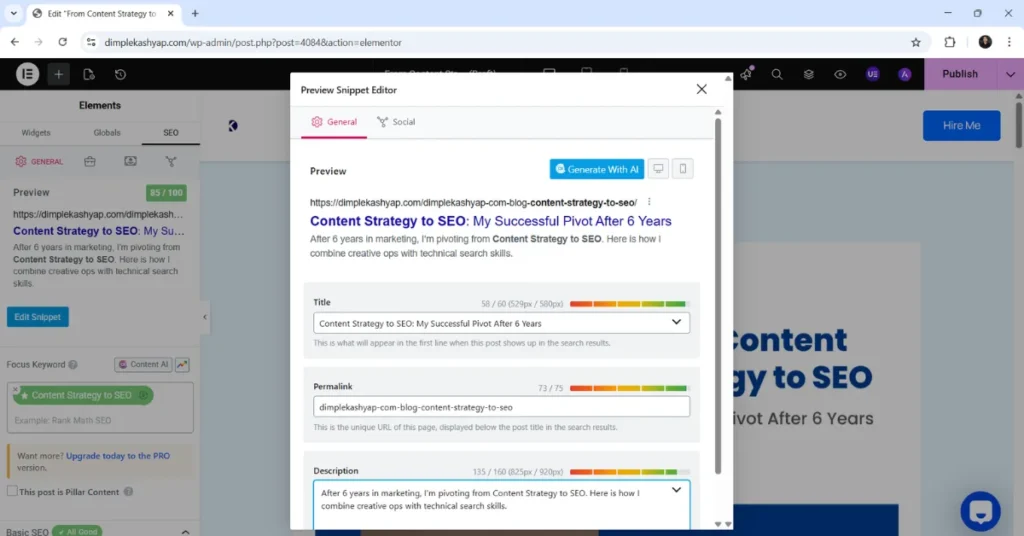
The creation of this site (DimpleKashyap.com) was the first step towards that. Doing everything with a digital asset: structure, performance, optimization, etc. made me realize that SEO is not a checklist, it is a system.
It is the place of the agreements between creativity, structure, and data.
Where This Journey Is Heading
I view this evolution from content strategy to SEO as the ultimate career level-up.
I am aware of the creative process and the coordination issues of content implementation. I am currently studying those technical processes that allow that material to rank, scale, and compound.
I am writing this journey – putting technical SEO to years of experience in working with content – right here.
Should you need a marketer that comprehends operations as well as optimization, you may Connect with me on LinkedIn.
This is not a career reset. It’s a strategic next step.